
Math Games
Is learning math a tough topic around the kitchen table, inciting fear in your child? Or is teaching your students math calculations like pulling teeth? Math can be an intimidating subject for many students. But, before a student can advance to more complex concepts, he/she must master arithmetic. "Math is too hard!" your child or student may exclaim, but don't despair!
Math Games is a fun collection of quiz games that will help your little student become a mathematics aficionado. With games on addition, subtraction, multiplication, and division, your students will actually enjoy themselves while learning to compute numbers quickly. So not only will their mathematical skills improve, but their ability to work swiftly and efficiently will flourish.
Enjoy studying with your child? Why not pull up a chair and brush up on your skills too. A teacher with a large class? How about creating an entertaining and educational environment by allowing all your students to work on the games simultaneously? Whatever way you choose to help your child or student better understand basic math operations, this set of games is sure to bring success.
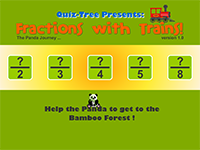
 Learn simple fractions with this fun game!
Math Games with Mr. Robot.
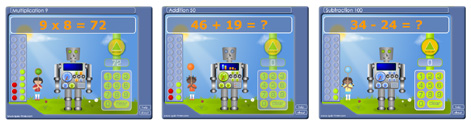
With the help of a team of characters, including Mr. Robot and his friends, playing Math Games is easy. To choose your response, simply punch in the number and click on the "answer" button. This shoots the response up to Mr. Robot, who reveals if your answer is correct. Can't have the sound on? No problem! Mr. Robot's friends also hold signs to indicate correctness: Green light = Correct; Red light = Incorrect. If the answer is incorrect, Mr. Robot recites the problem with the correct answer. After each quiz is completed, you have the option of returning to that quiz and repeating any incorrect problems. This allows you to review any challenging problems, moving you closer to math victory!

Other Resources.
Math Innovation + Hard Work = Math SuccessMath Games Multiplication for Windows
Math Games - Level 1
Math Games - Level 2